 Our Editorial Team —
Gold IRA Investing Guide (2026): How It Works, IRS Rules & Top-Rated Companies
Gold IRA investing delivers portfolio diversification outside equities and bonds, with IRS rules under IRC Section 408(m) governing which coins and bars qualify. Contribution limits for 2026 sit at $7,000 ($8,000 if age 50+), and rollovers from existing 401(k) or traditional IRA accounts carry no dollar cap. Custodians charge $50-$100 to set up the account and $75-$300 annually, making fee comparison among firms like Rosland Capital or Noble Gold an important first step.
A gold IRA lets you hold physical gold, silver, platinum, and palladium inside a tax-advantaged retirement account — giving your retirement portfolio a tangible inflation hedge that stocks and bonds cannot replicate. This guide explains 2026 IRS rules, contribution limits, approved coins and purity standards, rollover procedures, fee structures, and a ranked comparison of the five best-rated gold IRA companies currently open to new investors.
Top Gold IRA Companies 2026
Ranked by BBB rating, fee transparency, minimum investment, and customer service. Each company has been independently evaluated for IRS-approved depository partnerships, dealer premium over spot price, and buy-back spread policy.

Augusta Precious Metals
Best Overall Gold IRA Company
Goldco
Best for First-Time Investors
Birch Gold Group
Best Educational Resources
American Hartford Gold
Best Price Protection
Noble Gold Investments
Best for Royal Survival PacksTable of Contents
- 1 What Is a Gold IRA?
- 2 Types of Gold IRAs: Traditional, Roth, and SEP
- 3 How a Gold IRA Works: Custodians, Dealers, and Depositories
- 4 Approved Metals: Purity Standards and Eligible Coins
- 5 2026 Contribution Limits and IRS Rules
- 6 Gold IRA vs. Traditional IRA: Key Differences
- 7 Rollover and Transfer Options
- 8 Costs and Fees: What to Expect
- 9 Risks of Investing in a Gold IRA
- 10 Pros and Cons of a Gold IRA
- 11 Common Mistakes to Avoid
What Is a Gold IRA?
A gold IRA is a self-directed retirement account that holds physical gold and other precious metals instead of stocks and bonds. Your gold IRA custodian administers the account, processes purchases from a precious metals dealer, and coordinates storage at an IRS-approved depository — acting as the mandatory intermediary between you and your physical metals.
A gold IRA preserves every tax advantage of a traditional or Roth IRA — including tax-deferred growth and potential tax-free distributions — provided you comply with IRS rules on approved metals and custodial storage. Three structures are available: traditional gold IRAs (pre-tax contributions, tax-deferred growth), Roth gold IRAs (after-tax contributions, tax-free distributions), and SEP gold IRAs (for self-employed individuals with higher contribution limits).
Types of Gold IRAs: Traditional, Roth, and SEP
Gold IRAs come in three structures: traditional (pre-tax), Roth (after-tax), and SEP (for self-employed) — each following the underlying tax rules of its IRA type.
- Traditional Gold IRA: Contributions are made with pre-tax dollars. Growth is tax-deferred. Withdrawals are taxed as ordinary income. Required Minimum Distributions (RMDs) begin at age 73.
- Roth Gold IRA: Contributions are made with after-tax dollars. Growth is tax-deferred. Qualified distributions are tax-free. No RMDs during the owner's lifetime.
- SEP Gold IRA: Designed for self-employed individuals and small business owners. Higher contribution limits apply — up to 25% of net self-employment income, maximum $69,000 in 2026.
How a Gold IRA Works: Custodians, Dealers, and Depositories
Every gold IRA requires three parties: a self-directed IRA custodian who administers the account, a precious metals dealer who sources your metals, and an IRS-approved depository that stores them.
1) Choose a Specialized Custodian
Select an IRA trustee or specialized custodian that supports self-directed IRAs holding physical precious metals. Many gold IRA companies offer turnkey services that consolidate custodian selection, dealer access, and depository coordination. Evaluate fee schedules, depository partnerships, and customer service responsiveness before committing.
2) Open a Self-Directed IRA
Open a separate self-directed IRA dedicated to physical metals. Choose traditional for tax-deferred growth or Roth for potential tax-free distributions — depending on your tax situation and retirement timeline.
3) Fund the Account
Fund via annual contributions (up to $7,000, or $8,000 if age 50+), a trustee-to-trustee transfer from an existing IRA, or a direct rollover from a 401(k) or employer plan. Rollovers from qualified plans do not count against annual contribution limits.
4) Select IRS-Approved Precious Metals
Choose from gold, silver, platinum, and palladium that meet IRS fineness standards. Gold must be at least .995 fine (bars) or .9999 fine (most coins). Numismatic coins and collectibles are prohibited under IRC Section 408(m).
5) Purchase Through a Precious Metals Dealer
Your custodian directs the purchase from an approved precious metals dealer using IRA funds. The IRA — not you — legally owns every coin and bar; the custodian titles each piece to the account on purchase. The custodian manages settlement and shipping documentation.
6) Store at an IRS-Approved Depository
All gold IRA assets must be stored at an IRS-approved depository such as the Delaware Depository, Brinks SLC, HSBC, or IDS of Texas. You choose between segregated storage (your metals stored separately, fully tracked by lot, with individual storage insurance) or commingled storage (shared vault, lower cost). The IRS prohibits home storage of gold IRA assets and treats any such arrangement as an immediate taxable distribution — there are no exceptions.
How to Open a Gold IRA in 5 Steps
- Research and select a reputable gold IRA company and custodian
- Open your self-directed IRA account and complete the application
- Fund the account via contribution, transfer, or rollover
- Select IRS-approved coins or bars from a precious metals dealer
- Confirm depository storage and receive account confirmation
Approved Metals: Purity Standards and Eligible Coins
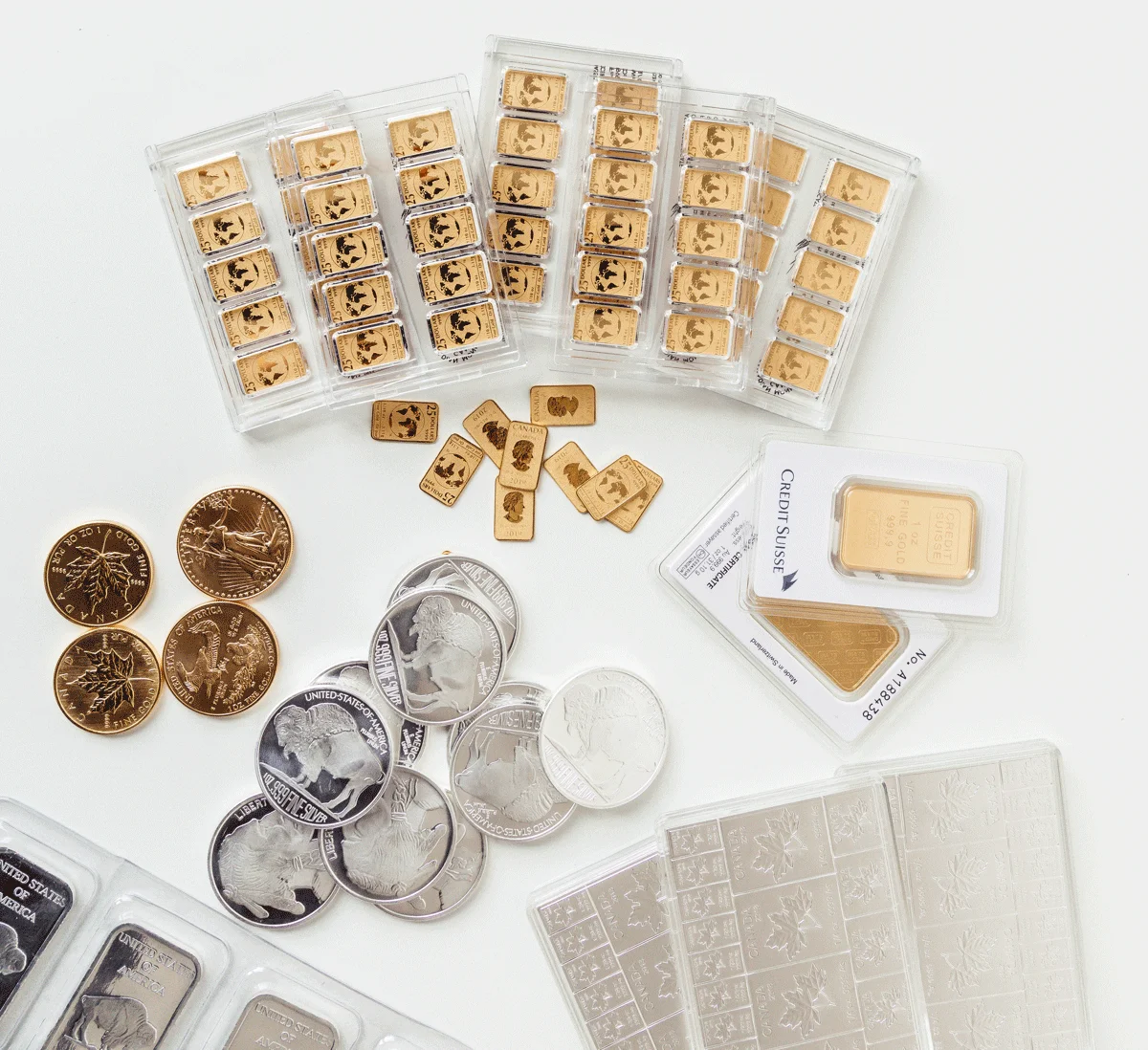
The IRS requires gold held in an IRA to be at least .995 fine (for bars) or .9999 fine (for most coins); eligible coins include the American Gold Eagle (22-karat, .9167 fine — an IRS exception), Canadian Gold Maple Leaf (.9999 fine), American Gold Buffalo (.9999 fine), and Austrian Gold Philharmonic (.9999 fine). Numismatic coins and collectibles are explicitly prohibited under IRC Section 408(m).
Gold (.995+ Fineness)
- American Gold Eagle — 22-karat (.9167 fine), IRS-approved by statute despite lower purity
- American Gold Buffalo — .9999 fine (24-karat), fully IRS-approved
- Canadian Gold Maple Leaf — .9999 fine, widely accepted
- Austrian Gold Philharmonic — .9999 fine, IRS-approved
- Gold bars and rounds — Must be .995 fine minimum, produced by NYMEX/COMEX-approved refiners
Silver (.999+ Fineness)
- American Silver Eagle — .999 fine, IRS-approved
- Canadian Silver Maple Leaf — .9999 fine
- Silver bars — Must be .999 fine minimum from approved refiners
Platinum and Palladium (.9995+ Fineness)
- American Platinum Eagle — .9995 fine
- Platinum and palladium bars — .9995 fine minimum from approved refiners
What is NOT allowed: IRC Section 408(m) explicitly prohibits numismatic coins, collectibles, and proof coins marketed for their collector value rather than bullion content. South African Krugerrands are also excluded (not statute-approved under U.S. law). Any coin or bar failing the applicable fineness threshold is ineligible. When evaluating bullion, compare the dealer's quoted price against the current spot price — a premium over spot above 5–8% warrants negotiation or a competing quote.
2026 Contribution Limits and IRS Rules
In 2026, gold IRA investors can contribute up to $7,000/year ($8,000 if age 50+), subject to the same limits that govern all traditional and Roth IRAs. These limits apply to the combined total across all your IRAs — traditional, Roth, and gold.
| Filing Status | Annual Limit |
|---|---|
| Under age 50 | $7,000/year |
| Age 50 or older (catch-up contribution) | $8,000/year |
Rolling over funds from a 401(k) or existing IRA does not count against annual contribution limits. (Source: IRS Publication 590-A, 2025 edition)
Key IRS rules for gold IRAs:
- Required Minimum Distributions (RMDs): Traditional gold IRA holders must begin taking RMDs at age 73. RMD amounts are calculated based on account value and IRS life expectancy tables. Roth IRAs are not subject to RMDs during the owner's lifetime.
- Prohibited Transactions: IRC Section 408(m) prohibits buying coins or metals you already own personally, using IRA assets for personal benefit, or engaging in self-dealing. Violations result in immediate distribution and tax liability.
- 10% Early Withdrawal Penalty: Distributions before age 59½ trigger a 10% penalty plus ordinary income tax on the full amount, unless a qualifying exception applies.
- IRS Form 5498: Your custodian files Form 5498 annually, reporting contributions, rollovers, and fair market value of your gold IRA. Keep this with your tax records.
- Once-Per-Year Rollover Rule: You may complete only one indirect (60-day) IRA rollover per 12-month period across all your IRAs combined. Trustee-to-trustee transfers are unlimited and not subject to this rule.

Gold IRA vs. Traditional IRA: Key Differences
A gold IRA differs from a traditional IRA in three critical ways: asset type (physical metals vs. paper assets), custodian requirements (specialized vs. standard brokerage), and fee structure ($200–$500/year vs. near-zero for index funds).
| Feature | Gold IRA | Traditional IRA |
|---|---|---|
| Assets held | Physical gold, silver, platinum, palladium | Stocks, bonds, mutual funds, ETFs |
| Custodian type | Specialized self-directed IRA custodian | Standard brokerage (Fidelity, Schwab, etc.) |
| Annual fees | $250–$800/year (custody + storage) | Near-zero (index funds); varies by fund |
| Contribution limit (2026) | $7,000 / $8,000 (catch-up) | $7,000 / $8,000 (catch-up) |
| Dividend/interest income | None — price appreciation only | Yes — stocks pay dividends, bonds pay interest |
| Storage requirement | IRS-approved depository (mandatory) | No physical storage required |
| Liquidity | 3–7 business days to liquidate | Instant (market hours) |
| Tax treatment | Same as IRA type (traditional or Roth) | Same as IRA type |
Gold IRA vs. Buying Physical Gold Directly
Physical gold bought outside an IRA has no contribution limits, no custodian requirement, and no storage rules — but you lose all tax advantages. Gold inside an IRA grows tax-deferred (traditional) or tax-free (Roth) but must be stored at an IRS-approved depository. Capital gains on physical gold held outside an IRA are taxed at the collectibles rate (28% maximum), which is higher than the long-term capital gains rate for most investors.
Rollover and Transfer Options
Use a direct trustee-to-trustee transfer — it is tax-free, penalty-free, and has no 60-day deadline. You can move funds from a 401(k), 403(b), TSP, SIMPLE IRA, or existing traditional IRA into a gold IRA this way. Avoid the 60-day indirect rollover unless necessary — it triggers 20% mandatory withholding on 401(k) distributions, which you must replace from personal savings and claim back at tax time.
- Trustee-to-Trustee Transfer (Direct): Your current custodian sends assets directly to the new gold IRA custodian. No funds pass through your hands. No 60-day deadline applies. No withholding. This is the simplest, cleanest method and is not subject to the once-per-year rollover rule. Eligible source accounts include traditional IRAs, 401(k) plans, 403(b) plans, TSP accounts, SIMPLE IRAs (after 2-year holding period), SEP IRAs, and other ERISA-qualified plans.
- Indirect Rollover (60-Day Rule): Funds are distributed to you personally. You have 60 days to redeposit the full amount into a qualified IRA. If you miss the deadline, the distribution becomes taxable income plus a 10% early withdrawal penalty if under age 59½. Your employer plan may withhold 20% for taxes — you must replace those funds from personal savings and claim a refund when filing. Only one indirect rollover is permitted across all IRAs per 12-month period.
Documentation: Your old plan administrator issues IRS Form 1099-R reporting the rollover distribution; your gold IRA custodian files IRS Form 5498 confirming receipt and the fair market value of the transferred assets. (Source: IRS Publication 590-A, trustee-to-trustee transfer rules)
Costs and Fees: What to Expect
Gold IRA investors typically pay $50–$300 in setup fees, $100–$300/year in custody fees, and $100–$200/year in storage fees — totaling $250–$800 annually before any dealer premium.
| Fee Type | Typical Range | Notes |
|---|---|---|
| Account Setup Fee | $50–$300 (one-time) | Some companies waive for large accounts |
| Annual Custody Fee | $100–$300/year | Charged by the self-directed IRA custodian |
| Storage Fee (Segregated) | $150–$300/year | Your metals stored separately, fully tracked |
| Storage Fee (Commingled) | $100–$150/year | Shared vault; lower cost |
| Dealer Premium over Spot Price | 3–8% above current spot price | The markup a dealer charges above the live gold spot price; shop multiple dealers to minimize this cost |
| Buy-Back Spread (Liquidation Markdown) | 1–3% below spot price | The discount below spot price a dealer pays when you sell; the combined buy/sell spread is your round-trip cost on the metal |
| Wire Transfer Fee | $25–$50 per transaction | Charged per wire when funding, rolling over, or liquidating |
Total first-year cost example: On a $50,000 rollover into a gold IRA: $80–$150 custodian fee + $150–$300 segregated storage fee at Delaware Depository, Brinks SLC, or IDS of Texas + 3–8% dealer premium over spot price on purchase ($1,500–$4,000) + 1–3% buy-back spread at liquidation. Total first-year all-in cost: typically $1,750–$4,450.
Fee drag on small accounts: On a $25,000 gold IRA, $500/year in fees equals a 2% annual drag on returns — before the dealer spread at purchase. Gold must appreciate at least 2% annually just to break even on fees. This makes gold IRAs economically inefficient for balances below $25,000. Always request a written fee schedule disclosing the dealer's markup methodology before signing a purchase agreement.
Risks of Investing in a Gold IRA
Gold IRAs carry fee drag, price volatility, zero income generation, and strict IRS storage rules — investors must weigh these against the diversification and inflation-hedge benefits before investing.
Fee drag on returns. Gold IRAs typically cost $200–$500/year in storage and custody fees on top of dealer premiums at purchase (2–5% above gold spot price). These fixed costs erode returns, especially on smaller balances below $25,000.
No dividends or interest. Physical gold generates zero passive income. Unlike dividend stocks or bonds, your return depends entirely on price appreciation. In decades where equities compound 8–10% annually via dividends and earnings growth, gold's zero-income profile is a significant competitive disadvantage.
Price volatility. Gold lost 28% of its value in 2013 and has experienced multi-year drawdown periods. It is not a guaranteed hedge — it is an uncorrelated asset with its own volatility profile. Physical gold and silver actively counterbalance equity volatility: during the 2008 financial crisis, gold climbed 25% while equities fell 37% (World Gold Council, 2024), demonstrating its low correlation during market stress — but past performance does not guarantee future results.
Liquidity constraints. Selling gold inside an IRA requires coordinating with your custodian and dealer. Liquidation can take 3–7 business days, versus instant execution for stocks or ETFs. If you need emergency cash from your retirement account, a gold IRA takes longer to access.
Early withdrawal penalty. Distributions before age 59½ trigger a 10% IRS penalty plus ordinary income tax on the full withdrawal amount. Unlike a brokerage account, there is no mechanism to sell gold quickly without consequences if you are under retirement age.
Home storage gold IRA is prohibited. The IRS requires all gold IRA assets to be held at an IRS-approved depository. Storing coins at home or in a personal safe — even temporarily — disqualifies the IRA and triggers immediate taxes and penalties on the full account value. Promoters of home storage gold IRA schemes misrepresent IRS rules; the IRS has explicitly ruled against such arrangements (IRS PLR 200217059).
Counterparty risk. While physical gold eliminates the counterparty risk of paper assets (stocks, bonds), it introduces custodian and depository counterparty risk. Choose FDIC-insured or Lloyd's of London-insured depositories with PCGS or NGC certification programs for maximum security.
Pros and Cons of a Gold IRA
Gold IRAs offer genuine diversification and inflation protection, but cost more and grow more slowly than low-fee index fund IRAs — making them best suited as a 5–15% portfolio allocation, not a primary retirement vehicle.
Pros
- Portfolio diversification: Physical gold and silver reduce concentration in stocks and bonds — correlations are historically low during equity market stress.
- Inflation hedge: Gold has historically functioned as a store of value during inflationary periods — over the 1970s decade of high inflation, gold rose approximately 1,500% (World Gold Council, 2024). During the 2008–2009 financial crisis, gold gained 25% while the S&P 500 declined 37%.
- Tax advantages: Same tax-deferred (traditional) or tax-free (Roth) growth as a standard IRA.
- Tangible asset: Physical metals with intrinsic value, not subject to corporate bankruptcy or bond default risk.
- Currency hedge: Gold tends to appreciate when the U.S. dollar weakens, providing a built-in hedge against dollar depreciation.
Cons
- Higher fees: $250–$800/year total cost (custody + storage + dealer premium) versus near-zero for index fund IRAs.
- No passive income: Zero dividends or interest. Return depends entirely on price appreciation.
- Liquidity: 3–7 business day liquidation timeline versus instant for equities.
- IRS complexity: Strict storage rules, approved metals lists, prohibited transaction rules, and RMD requirements add administrative burden.
- Long underperformance periods: Gold underperformed equities significantly during 1980–2000 and 2013–2018. A 5–15% allocation is recommended, not a primary holding.
Common Mistakes to Avoid
- Home Storage: Storing metals at home or in a personal safe violates IRS rules for a gold IRA and triggers immediate tax liability on the full account value. Always use an IRS-approved depository.
- Ineligible Metals: Numismatic coins, collectibles, and metals that fail fineness requirements are prohibited. Confirm eligibility before purchasing any coin or bar.
- Missing the 60-Day Rollover Deadline: If you take an indirect rollover, you have exactly 60 days to redeposit funds. Missing the deadline converts the distribution to taxable income plus a 10% early withdrawal penalty.
- Ignoring Fee Drag: Fixed annual fees of $250–$800 erode returns significantly on small accounts. Calculate the break-even appreciation rate before opening an account.
- Violating Prohibited Transaction Rules: Buying metals you already own personally, using IRA-owned metals for personal use, or self-dealing are prohibited transactions that disqualify the entire IRA.
- Over-allocating to Gold: Financial planners generally recommend 5–15% allocation to precious metals, not a primary retirement vehicle. Dollar-cost averaging into gold over time reduces entry-point risk.
- Skipping the Once-Per-Year Rollover Rule: Only one indirect IRA rollover per 12-month period is permitted across all IRAs. Excess rollovers are treated as taxable distributions.
Frequently Asked Questions
Minimums vary by company: Augusta Precious Metals requires $50,000; Goldco requires $25,000; Birch Gold Group accepts accounts from $10,000. There is no IRS-mandated minimum, but dealer economics make accounts below $10,000 cost-inefficient due to fixed annual fees of $250–$800/year.
Yes. A direct rollover (trustee-to-trustee transfer) from a 401(k) or traditional IRA to a gold IRA is tax-free and penalty-free. An indirect rollover (funds sent to you first) must be completed within 60 days to avoid taxes and the 10% early withdrawal penalty. The rollover amount does not count against your annual $7,000 contribution limit.
IRS-approved coins include: American Gold Eagle (22-karat, IRS-approved by statute), American Gold Buffalo (.9999 fine), Canadian Gold Maple Leaf (.9999 fine), and Austrian Gold Philharmonic (.9999 fine). Gold bars must be at least .995 fine from NYMEX/COMEX-approved refiners. Collectibles and numismatic coins are prohibited under IRC Section 408(m).
You can take an in-kind distribution (physical metals shipped to you) or a cash distribution (custodian sells metals, transfers proceeds). Both are taxable as ordinary income for traditional gold IRAs. Distributions before age 59½ also incur a 10% penalty. At age 73, Required Minimum Distributions (RMDs) begin for traditional gold IRAs.
Physical gold bought outside an IRA has no contribution limits, no custodian requirement, and no storage rules — but you lose all tax advantages. Gold inside an IRA grows tax-deferred (traditional) or tax-free (Roth) but must be stored at an IRS-approved depository. Capital gains on physical gold outside an IRA are taxed at the collectibles rate (28% maximum), higher than typical long-term capital gains rates.
Fidelity does not offer a self-directed gold IRA holding physical metals. Fidelity offers gold ETFs (e.g., iShares Gold Trust) and gold mining stocks within standard IRAs, but these are paper assets — not physical gold. For physical gold in an IRA, you must use a specialized gold IRA custodian.
Gold has risen approximately 26% YTD in 2026, driven by dollar weakness and geopolitical uncertainty. Financial planners generally recommend gold as a 5–15% portfolio allocation — not a primary holding — due to its higher fees, zero income generation, and long periods of underperformance relative to equities. A gold IRA is best suited as a diversification tool, not a replacement for a balanced retirement portfolio.
Gold IRAs can be a good fit for investors who want to diversify retirement savings with tangible assets and are comfortable with the unique costs and rules. However, they involve higher fees ($250–$800/year), no passive income, and strict IRS compliance requirements. Most financial planners recommend a 5–15% allocation to precious metals — not a primary retirement vehicle. Consult a CFP or tax advisor before making any retirement investment decision.
Is a Gold IRA a Good Idea for You?
A gold IRA makes sense for investors with $25,000+ to allocate, a retirement horizon of 10+ years, and a goal of diversifying 5–10% of their portfolio into a tangible inflation hedge. It is a poor fit for investors who need dividend income, are under age 45 with small balances (fixed annual fees consume returns), or need short-term liquidity.
Who Should Consider a Gold IRA
- Investors within 10–20 years of retirement seeking to reduce equity concentration and add an uncorrelated asset to their qualified plan or ERISA-governed 403(b), TSP, or SIMPLE IRA rollover.
- Investors with $25,000–$500,000 to allocate — the fee structure (custodian fee + segregated storage fee at Delaware Depository, Brinks, or IDS of Texas) is economically justified at this range.
- Inflation-concerned investors who want physical bullion rather than gold ETFs or gold mutual funds (no counterparty risk on the metal itself).
- Holders of old 401(k), 403(b), TSP, or SIMPLE IRA accounts who want to consolidate into a self-directed vehicle while maintaining tax-deferred or Roth status.
Who Should Avoid a Gold IRA
- Investors under age 45 with balances below $25,000 — $300–$600/year in fees equals 1.2–2.4% annual drag, making it very difficult to outperform a low-cost index fund IRA.
- Income-dependent retirees — physical gold and silver pay zero dividends; all return comes from spot price appreciation.
- Short-term savers — liquidation takes 3–7 business days and incurs a buy-back spread on the sale; this is not a liquid vehicle.
- Anyone seeking inherited IRA or beneficiary designation flexibility — gold IRA inherited IRA rules follow standard IRA rules but add logistical complexity around in-kind distribution and basis tracking on Form 1099-R.
Bottom line: A 5–10% gold allocation within a diversified retirement portfolio is broadly supported by financial planning research. A gold IRA as your only retirement account is not recommended by any major financial planning organization.
Gold IRA Scams and Red Flags to Avoid
Avoid dealers promoting "home storage LLC" checkbook IRA structures, rare numismatic coins, or "free silver" promotions — all three are regulator-flagged patterns cited in CFTC and FTC enforcement actions.
Common Gold IRA Scams
- Home Storage / Checkbook IRA LLC Structures: Promoters claim you can hold gold IRA assets at home using an LLC structure (sometimes called a "checkbook IRA"). The IRS has explicitly ruled against this arrangement (IRS PLR 200217059). Any home storage of gold IRA assets constitutes a prohibited transaction under IRC §408(m) and triggers immediate distribution, full income tax, and a 10% early withdrawal penalty. No legitimate custodian offers a "home storage gold IRA."
- Numismatic Coin Upsell: Some dealers push rare, collectible, or proof coins with massive markups over spot price — sometimes 50–300% above bullion value. Numismatic coins are explicitly prohibited inside IRAs under IRC §408(m)(3). A dealer who suggests proof coins or collectible gold is either uninformed or deliberately upselling. Only IRS-approved bullion coins and bars (meeting .995/.9999 fineness standards) belong in an IRA.
- "Free Silver" and Promotional Incentives: Dealers offering large amounts of "free silver" as a signup incentive typically recover that cost through inflated dealer premiums over spot price on the metals you buy. The total cost of ownership — including markup, buy-back spread, storage insurance, and wire transfer fees — should be evaluated before signing any paperwork.
- High-Pressure Sales Tactics: Legitimate gold IRA companies give investors time to review documents and consult advisors. If a sales rep creates urgency ("gold prices are about to spike — act now"), that is a red flag. FINRA's 2024 Investor Alert on Gold IRA Rollovers specifically warns against high-pressure rollover solicitations.
- Unverifiable Credentials: Verify that any CFP, CPA, or Enrolled Agent cited on a gold IRA site can be confirmed through CFP Board, AICPA, or IRS databases. Fabricated credentials are a documented FTC enforcement pattern in precious metals fraud cases.
How to Protect Yourself
- Check the dealer's BBB rating and complaint history — look for complaint volume, not just the letter grade.
- Confirm storage will be at a named, established depository: Delaware Depository, Brinks SLC, HSBC, or IDS of Texas.
- Ask for the full fee schedule in writing before any transfer: setup fee, annual custodian fee, segregated or commingled storage fee, dealer markup over spot price, wire transfer fee, and liquidation buy-back spread.
- Verify that the custodian is IRS-approved — not just "IRS-compliant" — and holds your assets in a qualified plan under ERISA standards.
What Investors Say
Hear from real customers about their Gold IRA experience

Diversifying into a gold IRA was one of the best financial decisions I've made. The process was straightforward and my advisor explained everything clearly.
May 2026
After researching precious metals for months, I finally opened my gold IRA. The peace of mind knowing I have tangible assets is invaluable.
April 2026
Great experience overall. The setup took a bit longer than expected but the customer service was excellent throughout the entire process.
March 2026